When you lose a tooth to injury, severe decay, or gum disease, replacing it helps restore your ability to chew comfortably and prevents adjacent teeth from drifting out of alignment.
The two most common fixed options for replacing a missing single tooth are a dental implant and a dental bridge. While both provide a natural-looking, stable replacement, they achieve this through fundamentally different structural approaches.
A dentist does not simply choose the most modern or expensive treatment. Instead, treatment planning involves evaluating the health of your surrounding teeth, the density of your jawbone, your gum condition, and your overall oral health goals.
What Is a Dental Implant?
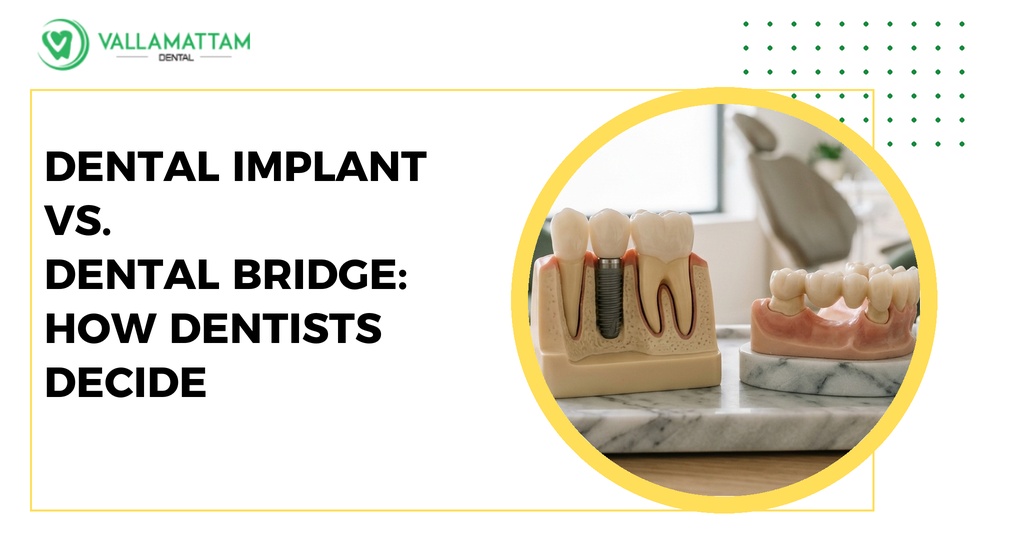
A dental implant is an artificial tooth root, typically made of biocompatible titanium, that is surgically placed directly into the jawbone beneath the gumline.
Over a period of several months, the implant fuses naturally with the surrounding bone in a biological process known as osseointegration. Once the implant has integrated securely, an abutment (connector) is attached, and a custom ceramic or porcelain crown is secured on top.
Because the implant is anchored in the bone, it functions independently without needing physical support from neighbouring natural teeth.
What Is a Dental Bridge?
A traditional dental bridge replaces one or more missing teeth by anchoring an artificial tooth (called a pontic) to the natural teeth on either side of the gap.
To support the bridge, the natural teeth adjacent to the space—known as abutment teeth—must be carefully reshaped by removing a layer of enamel. Custom dental crowns are then fitted over these prepared teeth, with the artificial replacement tooth suspended between them in a single, continuous restoration.
A bridge is cemented permanently into place and relies entirely on the structural strength of the neighbouring supporting teeth.
Key Differences: Implant vs Bridge
| Feature | Dental Implant | Dental Bridge |
|---|---|---|
| Support Mechanism | Anchored directly into the jawbone (independent artificial root) | Supported by crowns cemented onto neighbouring natural teeth |
| Impact on Adjacent Teeth | Neighbouring teeth remain untouched and intact | Healthy adjacent teeth must be shaved/reshaped for crowns |
| Jawbone Stimulation | Stimulates jawbone through chewing forces, helping prevent bone loss | Does not stimulate bone beneath the missing tooth gap |
| Treatment Timeline | Multi-stage process typically taking 3 to 6 months for bone fusion | Typically completed in 2 to 3 appointments over 2 to 3 weeks |
| Oral Hygiene & Cleaning | Flossed and brushed individually, just like a natural tooth | Requires special floss threaders or interdental brushes under the pontic |
| Surgical Requirement | Minor surgical procedure required for fixture placement | Non-surgical; tooth preparation and impression/digital scan only |
| Bone Density Requirement | Requires adequate jawbone volume and height (or bone grafting) | Does not require specific bone volume to support the pontic |
Key Factors Dentists Evaluate During Assessment
1. Condition of Adjacent Teeth
If the teeth on either side of the gap are healthy, strong, and have never had large fillings or decay, placing a dental implant allows your dentist to preserve their natural enamel completely.
Conversely, if the neighbouring teeth already have large fillings, recurrent decay, or require crowns themselves, placing a dental bridge can treat both the missing space and reinforce the damaged adjacent teeth at the same time.
2. Available Jawbone Density and Height
Because an implant must anchor securely into bone, your dentist will examine 3D scans (CBCT) or digital X-rays to assess bone volume. If a tooth has been missing for several years, the jawbone in that area may have naturally resorbed (shrunk). In such cases, bone grafting may be discussed before an implant is possible, whereas a bridge does not require bone grafting.
3. Gum Health and Periodontal Condition
Both implants and bridges require healthy, inflammation-free gums. Active gum disease (periodontitis) can compromise the bone supporting an implant or weaken the teeth holding a bridge. Gum health must be stabilized before permanent tooth replacement begins.
4. Systemic Health and Medical Factors
Certain general health conditions—such as uncontrolled diabetes, active smoking, or treatments affecting bone healing—can influence how predictably an implant integrates with bone. Your dentist reviews your complete medical history to recommend the lowest-risk approach.
5. Treatment Timeline Priorities
If you require a faster, non-surgical tooth replacement—for instance, ahead of an important life event—a bridge can often be completed in a few weeks, whereas an implant requires a healing period for bone integration.
Situations Where a Dental Implant May Be Considered
- The neighbouring teeth are healthy and untouched: Preserving natural tooth structure is a primary principle of conservative dentistry.
- You want to preserve jawbone volume: The implant stimulates the bone, helping maintain facial contour over time.
- Easy individual flossing is preferred: Implants can be cleaned with standard dental floss without threading tools.
- Long-term independent stability is desired: An issue affecting a neighbouring tooth in the future will not compromise the implant.
Situations Where a Dental Bridge May Be Considered
- Adjacent teeth already need crowns or large restorations: A bridge solves multiple restorative needs in one treatment.
- Jawbone volume is insufficient for an implant: When bone grafting is not feasible or preferred by the patient.
- A non-surgical option is preferred: For patients with medical contraindications to minor oral surgery.
- Faster completion timeline: When a functional replacement is needed within two to three weeks.
What Happens When a Tooth Is Not Replaced?
Leaving a gap unaddressed often leads to secondary complications over time:
- Teeth Drifting: Neighbouring teeth gradually tilt into the empty space, altering your bite.
- Super-Eruption: The opposing tooth in the other jaw can move downward or upward into the gap.
- Chewing Imbalance: Chewing forces shift disproportionately to one side of the mouth, causing uneven wear.
Frequently Asked Questions
Does getting a dental implant hurt?
The surgical placement is performed under local anaesthesia, meaning the area is completely numb during the procedure. Most patients report mild tenderness for a few days afterward, easily managed with standard pain relief.
How long does a dental bridge last?
With diligent oral hygiene and regular professional cleanings, dental bridges provide many years of reliable function. Keeping the margins of the supporting crowns clean with interdental brushes is critical to prevent decay beneath the bridge.
Can a bridge be replaced with an implant later?
Yes. If a bridge fails in the future due to decay on an abutment tooth, the bridge can be removed, and dental implants may be evaluated to replace the missing tooth or support new crowns.
What if I have multiple missing teeth in a row?
For several missing teeth, options include an implant-supported bridge (where two implants support three or four artificial teeth), a removable partial denture, or a multi-unit bridge.
The Value of Individual Clinical Assessment
There is no single “best” tooth replacement that fits every patient. The most appropriate choice depends on your oral anatomy, systemic health, bite alignment, and personal preferences.
If you are exploring tooth replacement options, a comprehensive clinical evaluation at Vallamattam Dental Clinic in Kakkanad can assess your bone structure, adjacent teeth, and gum health to help you choose a predictable, long-lasting restoration.
For patients currently deciding whether a damaged natural tooth can be preserved or requires extraction, read our clinical guide on root canal vs tooth extraction.

Clinical Review & Oversight
This guide was reviewed by Dr. Antony Kurian Vallamattam and the specialist team at Vallamattam Dental Clinic in Kakkanad, Kochi. Our clinicians specialize in endodontics, orthodontics, oral surgery, and periodontics.
Meet our dentists & specialists → · Book an appointment in Kakkanad